
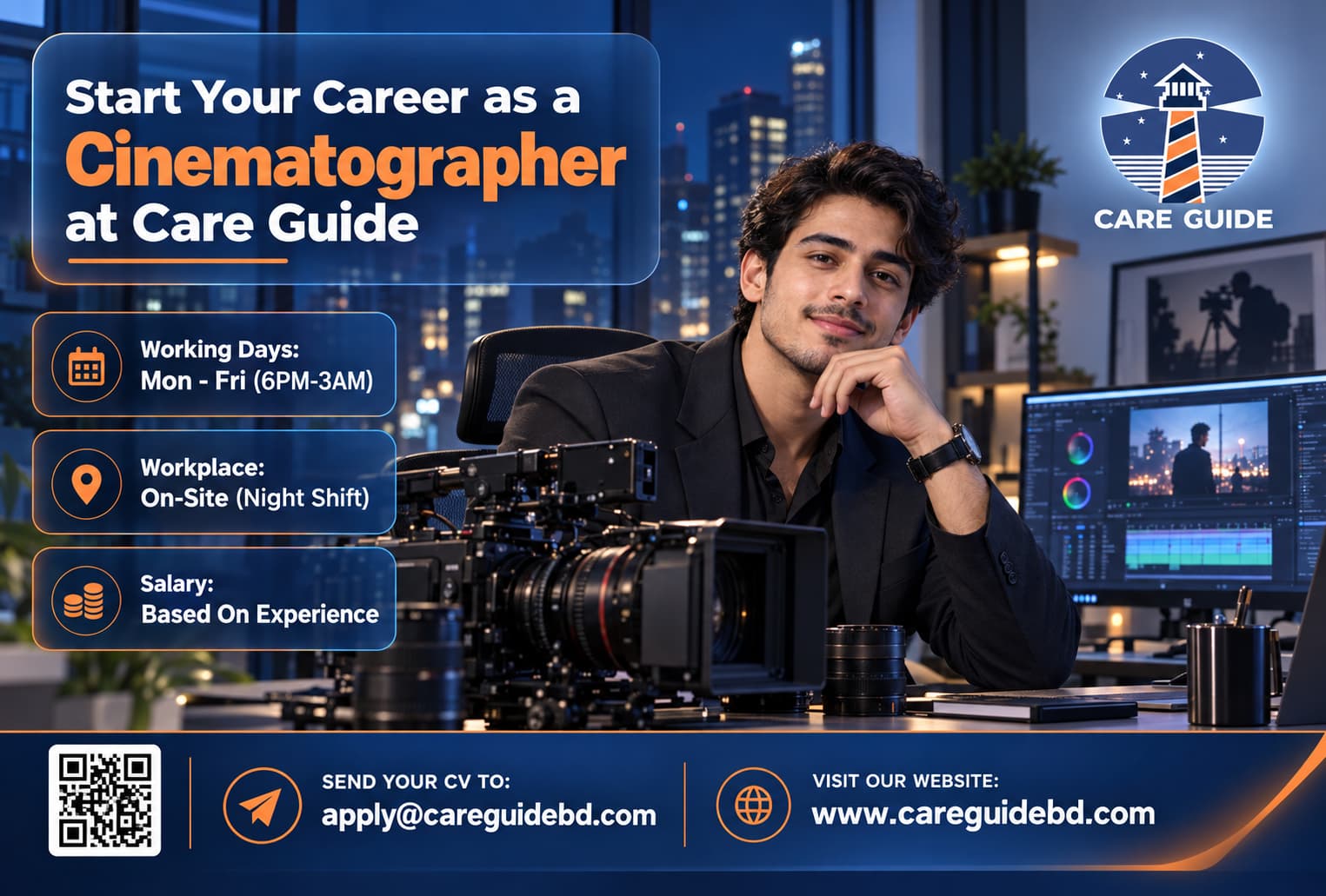
Cinematographer Jobs in Dhaka, Bangladesh: Build Your Visual Storytelling Career at Care Guide
Cinematography is where technical camera control and visual storytelling come together.
At Care Guide, the current Cinematographer role focuses on planning and shooting professional video content for marketing, branding, documentary-style and digital projects.
The role involves camera operation, lighting, framing, composition, on-location and studio production, collaboration with media and marketing teams, and proper care of production equipment.
A strong Cinematographer should understand not only how to operate a camera, but why a particular shot, lens choice, lighting setup or movement supports the story.
This guide explains the skills Care Guide currently looks for, what a useful cinematography portfolio should demonstrate, and how to decide whether your background fits the role.
Is Care Guide Hiring a Cinematographer in Dhaka?
Care Guide currently has an onsite Cinematographer opportunity in Mohakhali, Dhaka focused on professional camera work, lighting, framing, visual composition and high-quality video production.
The current vacancy requires a minimum of 2 years of professional experience as a Cinematographer or Videographer, with experience in promotional, documentary and digital content.
The role also requires practical experience with lighting, camera setups and on-location shoots. A bachelor's degree in Film, Media, Communication or a related field is preferred, while a diploma or professional cinematography training is considered a plus.
The current vacancy lists a 6:00 PM–3:00 AM night shift, Monday through Friday. Candidates should verify the active posting before applying.
What Is Professional Cinematography?
Professional cinematography is the craft of using cameras, lenses, lighting, framing, movement and visual composition to communicate a story or message through moving images.
A Cinematographer may work with:
- camera systems
- lenses
- framing
- composition
- lighting
- exposure
- camera movement
- gimbals
- audio coordination
- location planning
- shot continuity
- visual style
Technical competence matters, but the strongest cinematography decisions support the story, brand or communication objective.
Who May Be a Good Fit for Cinematography?
Camera-Focused Visual Storytellers
Candidates who can translate an idea or brief into deliberate shots, framing and movement.
Lighting-Focused Shooters
Professionals comfortable shaping scenes with practical, natural and production lighting.
On-Location Videographers
Candidates who can adapt camera and lighting setups to changing environments.
Production-Minded Creatives
People who can combine visual creativity with equipment care, planning and team collaboration.
What Does a Cinematographer Actually Do?
A Cinematographer helps plan and capture the visual material used in a finished video.
Typical responsibilities can include:
- reviewing a creative brief
- planning shots
- choosing camera setups
- choosing lenses
- setting exposure
- building lighting setups
- framing subjects
- operating camera movement
- working on location
- shooting in studio
- monitoring visual consistency
- collaborating with editors
- managing equipment
Care Guide's current vacancy specifically combines shooting, lighting, visual storytelling, team collaboration and equipment management.
Cinematographer vs Videographer: What's the Difference?
The titles can overlap, but Cinematographer often emphasizes visual strategy, lighting, composition and camera language, while Videographer may describe a broader end-to-end video-production role.
Employers use these titles differently. Candidates should focus on the actual responsibilities rather than title alone.
What Is the Difference Between a Cinematographer and a Video Editor?
A Cinematographer primarily captures footage during production, while a Video Editor primarily shapes footage during post-production.
The roles overlap through visual storytelling, continuity and understanding what footage will be useful in the edit.
Care Guide's current Cinematographer role lists basic video-editing workflow knowledge as a plus, but editing is not the central responsibility.
What Would You Actually Work On at Care Guide?
Marketing & Branding Shoots
Plan and capture video content that supports Care Guide's marketing and brand communication.
Promotional Content
Shoot polished visual material for promotional projects.
Documentary-Style Content
Capture people, environments and events in a way that supports clear storytelling.
Studio Production
Work with controlled lighting, camera setups and production environments.
On-Location Production
Adapt shooting setups to real-world environments and changing conditions.
Media-Team Collaboration
Work with media, editors and marketing teams to translate concepts into usable footage.
Equipment Management
Maintain cameras, lighting tools and shooting setups in organized working condition.
Already Shooting Professional Video Content?
If you can operate professional cameras, shape lighting, frame intentionally and show strong visual storytelling through real work, continue through this guide and compare your experience with Care Guide's current requirements.
Apply for CinematographerWhy Does Camera Operation Matter?
Camera operation is a core requirement in the current Care Guide role.
A Cinematographer should be comfortable controlling the camera deliberately rather than relying entirely on automatic settings.
- frame rate
- shutter
- aperture
- ISO
- white balance
- focus
- exposure monitoring
- recording formats
Why Is Lighting Important in Cinematography?
Lighting shapes visibility, mood, depth, texture and attention within a scene.
The current vacancy specifically requires experience with lighting and camera setups.
- key light
- fill light
- back light
- natural light
- practical lights
- contrast
- light direction
- color temperature
What Does Framing Mean in Cinematography?
Framing determines what appears inside the image and how the viewer's attention is directed.
- subject placement
- headroom
- lead room
- background control
- shot size
- balance
- negative space
- visual emphasis
Why Does Composition Matter?
Strong visual composition is explicitly part of Care Guide's current cinematography requirements.
Composition is how subjects, backgrounds, lines, shapes, light and space work together inside the frame.
What Is Visual Storytelling?
Visual storytelling means communicating meaning through images, shot choices, movement, lighting and sequence rather than relying only on dialogue or text.
The current vacancy specifically emphasizes strong visual storytelling and creative thinking.
How Do Lenses Affect a Shot?
Lens choice can influence field of view, perspective, depth of field and how close or distant a scene feels.
This is broader cinematography knowledge rather than a separately listed Care Guide requirement.
- wide-angle perspective
- normal perspective
- telephoto compression
- depth of field
- focus behavior
- low-light capability
Why Does Camera Movement Matter?
Movement can reveal information, follow a subject, create energy or change how a viewer experiences a scene.
The current role specifically mentions experience with professional cameras and gimbals.
- static shot
- pan
- tilt
- push-in
- pull-back
- tracking
- handheld
- gimbal movement
What Is a Gimbal Used For?
A gimbal helps stabilize a camera during movement so operators can produce smoother tracking shots.
Care Guide's current Skills & Expertise section references gimbal experience.
What Is Exposure in Cinematography?
Exposure controls how bright or dark an image is recorded. Cinematographers balance shutter, aperture, ISO, lighting and monitoring tools to achieve the intended result.
Correct exposure is important, but creative exposure choices should still preserve usable image information.
Why Does White Balance Matter?
White balance helps control how color temperature is represented. Incorrect settings can make neutral areas appear unintentionally warm, cool or tinted.
What Is Depth of Field?
Depth of field describes how much of the image appears acceptably sharp in front of and behind the focus point.
It can be influenced by aperture, focal length, camera-to-subject distance and sensor characteristics.
What Is Shot Continuity?
Continuity helps shots feel visually coherent when they are edited together.
- screen direction
- subject position
- lighting consistency
- eyelines
- camera height
- movement direction
- prop continuity
How Should Cinematographers Work With Audio?
Care Guide's current Cinematographer responsibilities include operating audio tools during shoots.
Cinematographers do not always serve as dedicated sound engineers, but they should understand how camera and audio capture need to coordinate during production.
How Important Are On-Location Shooting Skills?
The current vacancy specifically requires experience with on-location shoots.
Location work can require adaptation to space, available light, power, background noise, movement, weather and time constraints.
How Does Studio Shooting Differ From Location Shooting?
Studio work usually offers more control over light, sound and background. Location work often requires faster adaptation to existing conditions.
Care Guide's role includes both studio-based and on-site productions.
Why Does Equipment Management Matter?
Care Guide's current role includes maintaining and managing video equipment and shooting setups.
- camera bodies
- lenses
- batteries
- memory cards
- lights
- stands
- gimbals
- audio equipment
- cables
- cases
How Should a Cinematographer Collaborate With Editors?
Editors need usable coverage, continuity and technically sound footage. Good production planning can reduce problems in post-production.
The current Care Guide role expects collaboration with editors and other creative team members.
How Should a Cinematographer Collaborate With Marketing Teams?
Marketing teams may define the audience, message, campaign objective, platform or brand requirements.
The current vacancy specifically includes collaboration with media and marketing teams.
Why Does Brand Consistency Matter in Video Production?
The current role requires visual consistency and brand alignment across video projects.
A Cinematographer may need to consider lighting style, composition, visual tone, color direction and recurring production standards.
Does Basic Video Editing Knowledge Help?
Yes. Care Guide currently lists basic knowledge of video-editing workflows as a plus.
Understanding editing can help a Cinematographer capture better coverage and avoid footage that is difficult to assemble.
What Education Does Care Guide Prefer?
The current vacancy prefers a bachelor's degree in Film, Media, Communication or a related field.
A diploma or professional training in cinematography is listed as a plus. The degree is described as preferred, not as an absolute mandatory qualification.
How Much Cinematography Experience Does Care Guide Require?
The current vacancy requires a minimum of 2 years of professional experience as a Cinematographer or Videographer.
Experience shooting promotional, documentary and digital content is specifically requested.
Does Healthcare, Education or Corporate Media Experience Help?
Yes. Prior experience in healthcare, education or corporate media is currently listed as a plus.
What Should a Cinematographer Portfolio Include?
A useful cinematography portfolio should make your actual shooting ability easy to evaluate.
- Camera Work: Show footage that demonstrates controlled exposure, focus and framing.
- Lighting: Include examples showing intentional lighting choices.
- Composition: Demonstrate deliberate use of space, depth and visual hierarchy.
- Movement: Show stable and purposeful handheld, tripod or gimbal work.
- Location Work: Include examples from real-world environments where possible.
- Studio Work: Show controlled production setups if available.
- Storytelling: Include sequences that communicate clearly rather than only isolated beautiful shots.
- Your Contribution: Explain what YOU shot, lit or operated.
Should a Cinematographer Have a Showreel?
A concise showreel can help reviewers quickly understand your visual range.
- lead with your strongest work
- keep quality consistent
- avoid filler
- identify your contribution
- use clean exports
- make the portfolio easy to access
What Projects Can Demonstrate Cinematography Skills?
EXAMPLE PORTFOLIO PROJECT TYPES — NOT OFFICIAL CARE GUIDE TEST ASSIGNMENTS.
- brand promotional video
- short documentary
- corporate interview
- product video
- event coverage
- social-media campaign shoot
- studio interview
- location-based story
- gimbal sequence
- before/after lighting example
What Is the Care Guide Cinematographer Work Schedule?
The current Cinematographer vacancy lists a 6:00 PM to 3:00 AM schedule, Monday through Friday.
Candidates should realistically consider:
- sleep schedule
- transportation
- equipment logistics
- night-shift concentration
- location-shoot requirements
- long-term schedule sustainability
Who Should Probably Not Apply for This Cinematographer Role?
This opportunity may not be appropriate if:
- you do not meet the current professional-experience requirement
- you have no practical camera-operation experience
- you cannot demonstrate lighting ability
- you do not understand framing or composition
- you cannot show real shooting work
- you cannot work on location
- you cannot collaborate with creative teams
- you cannot manage equipment responsibly
- you are looking only for remote work
- you cannot work the required night shift
What Skills Can You Strengthen in Cinematography?
Professional cinematography work can deepen experience in:
- camera operation
- lighting
- framing
- composition
- visual storytelling
- gimbal operation
- location shooting
- studio shooting
- exposure
- lens selection
- shot planning
- continuity
- equipment management
- team collaboration
- brand alignment
What Should You Put on a Cinematographer CV?
Make practical production experience easy to evaluate. Include relevant:
- years of cinematography/videography experience
- camera systems used
- lighting experience
- gimbal experience
- promotional shoots
- documentary work
- digital content
- studio work
- location work
- equipment management
- editing-workflow knowledge
- education/training
- portfolio link
- showreel link
- industries served
How to Prepare for a Cinematographer Interview
Prepare to explain your visual decisions, not only your equipment list.
Review your own portfolio carefully. Be ready to explain:
- the brief
- shot planning
- camera choice
- lens choice
- lighting
- exposure
- framing
- composition
- movement
- location challenges
- team collaboration
- equipment setup
- final result
Example Questions Worth Preparing For
EXAMPLE PREPARATION QUESTIONS — NOT GUARANTEED CARE GUIDE INTERVIEW QUESTIONS.
- Tell us about your professional Cinematography or Videography experience.
- Walk us through a shoot you are proud of.
- How do you plan a shot before production?
- How do you decide how to light a scene?
- How do you control exposure?
- How do you choose a lens for a shot?
- What makes a composition effective?
- How do you approach camera movement?
- How have you used gimbals?
- Tell us about a difficult on-location shoot.
- How do you maintain continuity across shots?
- How do you collaborate with editors?
- How do you work with a marketing or creative brief?
- How do you protect and organize production equipment?
- Which project in your portfolio best represents your work?
- Can you reliably work the required night shift?
Should You Apply? Check Your Cinematography Skills
CORE FIT:
RELEVANT ADVANTAGES:
Do Your Cinematography Skills Match the Role?
If your production background matches the current requirements and your portfolio demonstrates strong camera work, lighting, composition and visual storytelling, submit your application through Care Guide's interview system.
Build Your Cinematography Career at Care Guide
Care Guide recruits professionals across creative, digital, technology, operational and professional roles in Dhaka, Bangladesh.
Cinematographers help turn concepts, campaigns and real-world stories into professional visual content through deliberate camera, lighting and composition choices.
Applicants should choose the role according to their actual shooting experience, technical skill, portfolio quality and schedule availability.
Explore All Care Guide Careers →
Looking for a Different Career at Care Guide?
Frequently Asked Questions About Cinematography Careers at Care Guide
Is Care Guide hiring a Cinematographer?
Care Guide currently has an onsite Cinematographer opportunity in Mohakhali, Dhaka focused on professional video production, camera operation, lighting, framing, composition and visual storytelling.
How much experience does Care Guide require?
The current vacancy requires a minimum of 2 years of professional experience as a Cinematographer or Videographer.
What education is preferred?
A bachelor's degree in Film, Media, Communication or a related field is preferred. A diploma or professional training in cinematography is listed as a plus.
Does Care Guide require professional camera experience?
Yes. Proficiency in camera operation is part of the current role requirements.
Does the role require lighting skills?
Yes. Lighting, camera setups, framing and composition are explicitly part of the current requirements.
Does the role involve on-location shooting?
Yes. Experience with on-location shoots is specifically requested, and the responsibilities include on-site video production.
Does the role involve studio production?
Yes. The current responsibilities include both on-site and studio-based video productions.
Does gimbal experience help?
Yes. Experience with professional cameras, gimbals and lighting tools is included in the current Skills & Expertise section.
Does video-editing knowledge help?
Yes. Basic knowledge of video-editing workflows is currently listed as a plus, though cinematography remains the core function.
Does healthcare or education media experience help?
Yes. Prior experience in healthcare, education or corporate media is listed as a plus.
Is this an onsite role?
Yes. The current position is office-based in Dhaka, Bangladesh.
What is the work schedule?
The current Cinematographer vacancy lists a 6:00 PM to 3:00 AM shift, Monday through Friday.
Do I need a portfolio?
The current application instructions ask candidates to send an updated CV and portfolio. A portfolio or showreel should clearly identify your own shooting contribution.
How do I apply?
Candidates who meet the current requirements can apply through Care Guide's online interview portal.
Apply for CinematographerThink This Cinematographer Opportunity Fits You?
You now understand the camera, lighting, composition, location-production and visual-storytelling skills involved in Care Guide's Cinematographer role. If your background matches the current requirements and your portfolio demonstrates strong professional work, submit your application.




Leave Comment